
New in FateView™: Label-Free Colony Detection
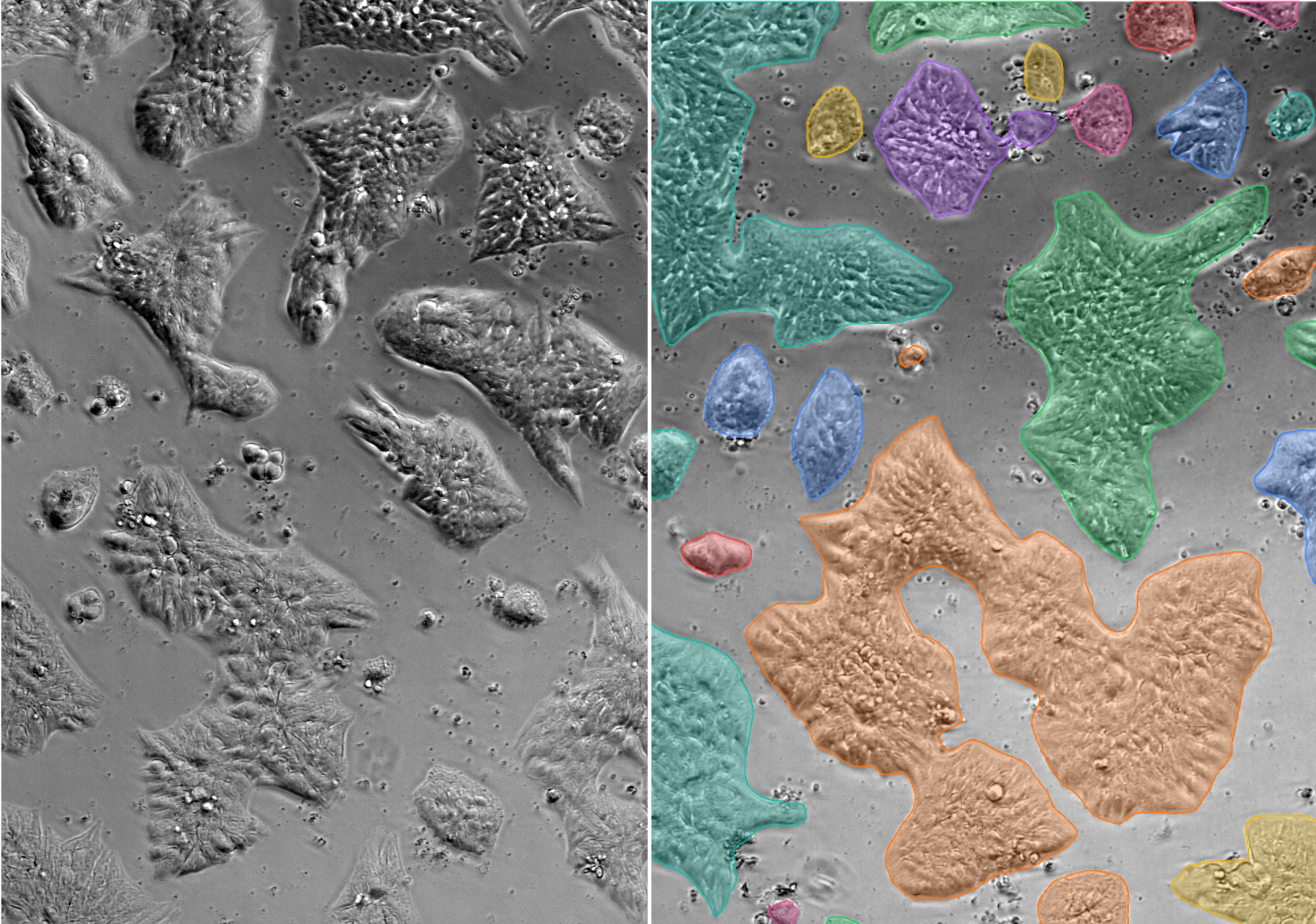
FateView™ Colony Detection is a label-free assay that enables continuous, quantitative monitoring of colony number and cell confluence in adherent cultures.
The Challenge: Moving Beyond Subjective Colony Assessment
In adherent culture systems, colony formation and cell confluence are critical indicators of cellular health and downstream potential. Yet in practice, assessment is often manual, subjective, and performed at limited timepoints.
As a result, key decisions—such as when to passage, initiate an experiment, or intervene—are frequently based on delayed or inconsistent readouts. This limits how effectively teams can respond to emerging culture dynamics and establish reproducible workflows.
The Solution: Quantitative, Label-Free Colony Detection
FateView™ Colony Detection provides a consistent and scalable way to quantify colonies and measure cell confluence directly from brightfield or phase-contrast microscopy images.

Example output from FateView™ Colony Detection, comparing a raw microscopy image with automated colony detection and confluence analysis.
This capability enables a shift from static, timepoint-based subjective assessment to continuous and quantitative analysis. Key features include:
- Automated Readouts: Generates structured data, including Colony Count and Confluence.
- Non-Invasive Monitoring: Quantitative readout without the need for staining or toxic dyes.
- Plug-and-Play Integration: No per-experiment optimisation required; evaluated across a wide range of cell types and compatible with existing imaging infrastructure.
Informing Process Decisions with Real-Time Data
By standardising how colonies are detected, the assay provides a reliable basis for comparing conditions, monitoring process progression, and identifying deviations earlier in a workflow.
In biotechnology and drug discovery, colony formation and cell confluence are key indicators for decision making— particularly in workflows such as gene editing and drug screening, where they help inform when to passage cells or initiate experiments.
Watch FateView™ in action: Automated analysis of colony number and cell confluence across timepoints.
Importantly, this is not only about automating colony counting and confluence measurement. By structuring data in a consistent and scalable way, FateView™ creates a foundation for more advanced analyses, including custom predictive assays and integration into broader modelling workflows.
Integrated Intelligence: Empowering Results with FateDrive™
When integrated into the broader Cell Predictive AI Platform, these structured readouts can be used within FateDrive™ to model the relationship between process conditions and outcomes.
In internal and partner-led work, real-time monitoring of confluence has been used to inform on-the-fly adjustments to culture protocols, contributing to substantial improvements in process performance, including observed increases in cell yield under specific conditions.
To explore how these data points are used for predictive modelling and process optimisation, visit FateDrive™.
Experience the Future of Colony Detection
The Colony Detection assay is now available as part of the FateView™ platform.
Evaluate FateView™ Colony Detection on your own data.
FateView™ Colony Detection is a label-free assay that enables quantitative analysis of colony number and cell confluence from microscopy images, providing structured and reproducible readouts to support cell culture decision-making.